
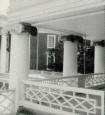
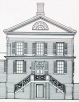
Thomas Jefferson designed the portico on the west facade using the Ionic order from the Temple of Fortuna Virilis as published by Palladio. The columns have attic bases on plinths, unfluted shafts, and Ionic capitals. The bases and capitals are of stone, and the shafts are of stuccoed brick. The capitals have volutes on the front and back and balusters on the sides, except for the capitals at the ends, which also have volutes on the exposed side (north or south). Where two volutes come together at the corner, they are splayed. The wooden entablature (4'0-1/4" deep) has a three-fascia architrave, a frieze ornamented with foliate swags draped between alternating putti and bucrania in high relief, and a denticulated cornice, which also contains an ovolo ornamented with an egg-and-dart motif. The wooden pediment above the cornice has a surface of flush boards and a nineteen-light semi-circular window with a single-fascia architrave (TypeT-16) in the center. The pediment is capped by a raking cornice.
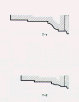
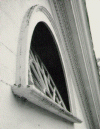 The wood entablature moldings from the top include the cornice, which has a cyma tium with a fillet and a cyma recta; a corona consisting of a fillet, a cyma reverse, a fillet, a fascia with a congé at the top; and a bedmolding consisting of an ovolo with egg-and-dart ornament, a fillet, a dentil course, a fillet, a cyma reverse, and a fillet. The substrate and the eggs of the egg-and-dart ornament are of carved wood to which delicately cast lead darts were attached. The frieze is a fascia with a congé at the top and bucrania and putti connected by foliate swags in high relief. Portions of this ornament are made of cast lead. In 1822 William Coffee supplied 34 feet of lead frieze ornament; the existing frieze is the same length. The architrave has a fillet, a cyma reverse, a fascia, an astragal, and two fasciae.
The deep entablature of the portico, with a plain rather than an ornamented frieze, is carried around the three remaining sides of the original structure as a unifying element. Above the entablature, there was until recently a slate shingle roof with a built-in gutter near the eave line. The c. 1822 brick chimney near the center of the building projects four courses above the ridge, corbels back, continues up eighteen courses, and ends in a five-course brick cap.
 A shallower wooden entablature (2' 0" deep) with a single-fascia architrave, a plain frieze, and a simple, unornamented cornice, containing a built-in, bituminous-coated, metal-lined gutter, caps the addition to the rear. The flat roof of this addition has a flat-seam metal roof (pans 20" by 28") covered with a bituminous coating. There is a brick chimney (1' 9" wide by 3' 6-1/2" deep) projecting twenty-two courses to a four-course brick cap at the south end of the roof.
The west facade is deeply recessed behind the columns of the portico. The facade is constructed of hand-made red brick, varying slightly in size, laid in Flemish bond with king closers at the window openings and queen closers at the ends. The brick are 7-7/8" to 8" long by 3-3/4" wide by 2-1/8" to 2-1/4" high, with six courses equal to 1' 3" to 1' 3-1/8''. The mortar in the narrow joints is recessed at the edges and nearly even with the faces of the brick in the center. Much of the mortar under the portico, where it has been protected from the weather, appears to be original. There are traces of a red wash that was applied to the brickwork at an unknown time. The mortar joints were painted white.
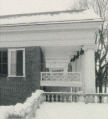
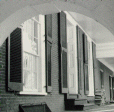 The pavement of the portico on the first story is twentieth-century brick laid in herringbone pattern with a one-brick wide border parallel to the facade. The ceiling above is of random-width beaded board running east-west and has a recent light fixture with a ribbed glass globe near the center. There is a 1-1/4" high molding (ovolo, fillet, cavetto) at the juncture of the ceiling and the wall. Two wooden steps lead to the original quartzite threshold of the doorway in the center bay. The steps are 5' 8-1/8'' wide and 1' 1-1/2'' deep including a 1-3/4" nosing, with risers approximately 7-7/8" high; the bottom tread is 2-1/2" thick and the top tread is 1-3/4" thick. There is a cavetto molding applied beneath the torus forming the edge of the tread. The original entrance door (Type D-10) and the transom above are set in a 1' 1-1/4'' deep reveal with raised panels corresponding in dimension and placement to those of the door. The paneled reveal as well as the two-fascia architrave encompassing both the door and the transom (8-1/4'' wide with two fasciae, a cyma recta, and a fillet, Type T-3) and the molding between them (fillet, cyma reverse, fascia, ovolo. and two astragals, Type T-40) have recently been sand-painted to resemble stone. Paint analysis did not indicate that the woodwork was sand-painted originally. The original rectangular transom is divided into nineteen lights by delicate semicircular and radiating muntins.
The door is flanked by two-panel blinds supported by original strap hinges and pintles. The blind to the south has a semicircular hole 2" in diameter cut for access to the door bell button. The strap hinges are 2' 1" long by 1-3/8" to 1-1/2" wide. The north holdback appears to be original and is located on the side of the blind approximately 1' 4" above the lower edge of the blind in its original position. A filled hole in the masonry indicates that a holdback may have been located at the bottom nf the blind at some time. The holdback for the south blind is located below the blind; patched holes in the masonry to both the side and bottom of the blind indicate possible previous locations. The blinds have an original iron swinging bar latch. The north blind has an oval plate (2-1/8' wide by 4-3/4", high by l/8" thick with a 1/8" bevel on the top edge) with a pivot in the center that holds a bar (1-1/2" wide and 5/16" thick) rounded at the ends. There is a keeper on each blind. Each keeper has a trefoil-shaped base fastened to the blind with three screws and a 1/8" thick U-shaped section to hold the bar.
On either side of the steps to the doorway there are original small basement windows, which are partially above grade and partially below grade facing small wells below the surface of the pavement. The windows are framed by 6-1/2'' wide two-fascia architraves and filled with wooden frames containing screens of 1/4" hardware cloth. There are three-pane, top-hinged, in-swinging sash behind the screens. The window wells are protected by sloped wood frames containing 1/2" hardware cloth, which date from the twentieth century.
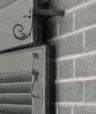 The windows on the first floor, in openings as tall as that of the central doorway, have 6-1/2" wide two-fascia architraves (Type T-15) at the sides and top and 2-1/2" thick sills at the bottom. They have 6/6/6 triple-hung sash. All of these elements are original. The windows are flanked by blinds, two on either side of each window, supported on early 1' 3" long wrought-iron strap hinges on pintles. The blinds appear to be early except for the bottom blinds on both sides of the south window, which are relatively new. Each of the blinds has a spiral-shaped holdback, and some of them have hooks and eyes. In addition to the strap hinges, the blinds have the following hardware: North window, north side, top blind: holdback at side, two eyes in bottom rail; one eye with hook and one eye, top rail. North window, north side, bottom blind: holdback at bottom, one eye with hook and one spike, bottom rail. North window, south side, top blind: holdback at side, two eyes in bottom rail. North window, south side, bottom blind: holdback at bottom (hole in masonry at bottom suggests another possible location for holdback), eye with hook in bottom rail. South window, north side, top blind: holdback at side, one eye with hook and one eye in bottom rail. South window, north side, bottom blind: holdback at bottom. South window, south side, top blind: holdback at side, one eye with hook and one eye bottom rail. South window, south side, bottom blind: holdback at bottom.
The articulation of the second story of the west facade also includes a door in the center bay and a window at either side each with two-fascia architraves (6-1/2± wide). The architrave around the door is Type T-5; those around the windows are Type T-15. The cyma recta moldings on these architraves are rather fat and crude compared with other moldings on the building. There is a twentieth-century two-panel screen door with two 3-3/4" spring hinges, a painted pull on the west, and a horizontal brass sliding bolt and keeper on the interior. The sides and top of the reveal behind the screen door are paneled. Each of the two leaves of the door behind (Type D-19) has three panels. The doorway is located two risers above the porch floor. Each of the risers is approximately 8-1/4" high. The tread of the step is 1' 0-1/4'' deep with a 1" nosing and 4' 10-1/2'' wide. The original windows have 6/6 double-hung sash. The original blinds on either side of the windows are held open with holdbacks. They also have hold-open devices consisting of a long rod with an eye at one end attached to a supporting bracket and a clothes-hook-type bracket on which the rod rests. There are recent aluminum screens in aluminum channels in front of the bottom sash.
The porch, beginning 5" behind the inside face of the columns, is hung from the structure at the attic floor level by four 3/4" diameter iron rods. The porch has a floor of random-width (4-1/4" to 5-3/4"), beaded, tongue-and-groove boards, which slopes from the exterior wall to the west. The porch floor is covered by flat-seam sheet-metal roofing (20" by 28" pans) for about 3' on both the north and south ends. A molding runs across the front and north end of the balcony; it is 8" wide in the front and increases in width across the north end so that it is 1' 1" deep where it meets the building. The molding profile from top to bottom includes a torus, fillet, cavetto, astragal, fillet, cavetto, fascia, cyma reverse, fascia, quirk, and flush bead. The middle fascia in the molding on the north end increases in width to make up for the slope of the porch. Above the molding is a wood rail 2' 11" high with a bottom rail, a top rail (4" wide by 3-3/4" high), panels behind the columns, and 1-1/4" by 2 -1/2'' wood members forming triangles, diamonds, and trapezoids between. The railing on the three bays of the west side and on the north end is original. The railing across the south end of the porch was added in the twentieth century. The ceiling of the porch is painted plaster. Just below the ceiling at the south side and the south half of the west side, 2" by 3" members are fastened to the iron rods supporting the porch and to the face of the masonry. These appear to have been installed as supports for sun screens.
 The five-bay north facade of the original building is laid in Flemish bond of brick similar to those on the west facade. There are windows in the four eastern bays of the basement story, in the three eastern bays of the first story, and in all five bays of the second story. The masonry at the basement level is covered with painted stucco. The surface of the stucco was scored to resemble stone masonry with blocks approximately 12" high by 18" long. The heavy paint coating partially fills the grooves, and portions of the stucco have been patched without the score lines.
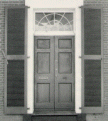
 The windows on the basement level have 3/6 sash and two-fascia architraves (Type T-7, except that of the second window from the west, which is Type T-8). The windows in the original portion have sills 1-3/4" thick projecting 1-1/2" from the face of the wall with a 3/8" square drip; the two window sills on the addition to the east are 3" thick and project approximately 1" from the face of the wall. The middle fascia, the cyma recta, and the fillet of the architrave on the second window from the west have been replaced relatively recently as indicated by chatter marks from a power plane on the moldings. The entire window openings of the first, third, and fourth windows from the west are covered by aluminum screens in aluminum channel frames. All of the windows on the first and second floors have original 6/6 double-hung sash and two-fascia architraves (Type T-15). There are aluminum screens in aluminum channel frames covering the lower sash of each window. The windows on the first and second floors have blinds which are relatively recent replacements.
 Holes in the masonry at the west end of the north facade indicate that there was a leader in this area at one time; it may have angled towards the east along the wall of the basement story to the location of a drain approximately six feet east of the west edge of the facade. At the east end of the facade of the original portion of the building is an exposed 4" diameter cast-iron soil stack that has connections to the bathroom in the basement, the kitchen on the first floor, and the bathroom on the second floor. The stack is broken off approximately 1' 4" below the entablature. Holes in the masonry near this stack indicate that there was a leader in this location in the past.
There are two windows in the basement and two windows in the first floor of the addition at the east end of the facade. Those in the basement have 3/6 sash with 5" wide architraves (Type T-9) and are covered by aluminum screens in aluminum frames. The windows in the first floor have 6/6 double-hung sash and two-fascia architraves (Type T-10). They are flanked by blinds on strap hinges with pintles on a rectangular base, which are more recent than the pintles on nearly square bases used in most of the windows of the earlier portion of the building. There are aluminum screens over the lower sash.
 The ground floor of the east facade of the addition on the rear of the building has a doorway in the center and windows on either side. The door has a 4-3/4" wide architrave (Type T-2) with a later profile (1953), and the windows have 5" wide architraves. The south window architrave (Type T-11) is composed of original circa 1822 trim probably from the original rear wall. The north window architrave (Type T-10) dates from the late nineteenth century. The brick (8" to 8-3/4" long by 3-3/4"to 4" wide by 2-1/2" high and laid so that six courses plus joints equal 1' 6-1/8") is laid in American bond with five stretcher courses followed by a header course. Two courses above the door, the masonry steps back 1-3/4", carrying the line of the watertable around the building. The 1-1/8'' thick, stile-and-rail, two-panel screen door in the center has a pair of 3" butts, a brass-plated mortised steel lock and latch set, a spring closer, and a hook and eye. The keeper is 3/4" wide by 1-3/4" high, and there is evidence of an earlier keeper. The lock and latch set has 1-3/4" diameter roses both sides and a 1-3/4" knob onthe exterior and a lever handle and locking lever on the interior. The spring closer is a Storm King model 105 by 5-B Mfg. Co. Ltd. There is a 1' 0" plain reveal with a 1' 0-1/2" molding on the exterior and a 2-3/4" wide beveled molding on the interior. The door of vertical beaded boards (Type D-7, 1953) has a pair of 4" butts and a cast-iron box lock with a brass knob on the exterior. The 3" thick masonry step below the door has a bullnose edge. The windows have 3/6 double-hung sash with 12" x 12" panes.
On the first floor the central doorway (1953) has a 3-1/4" high stone sill and is bordered on the sides and top by a 6-1/2" wide sand-painted, two-fascia architrave (Type T-4). Each of the two leaves of the stile-and-rail screen door has two panels and is mounted on a pair of 3" butts. The north leaf has a brass mortised lock and latch set with a plate (1-1/2" wide by 4" high) each side and a lever handle on the exterior and a 2" diameter knob on the interior. This leaf also has a spring closer mounted on the top rail. The south leaf has a keeper and brass surface-mounted slide bolts top and bottom. There is a 1-1/2" stop behind the screen door and then a 7-3/8" paneled reveal, with panels corresponding in size and location to those in the door, behind that. Each of the two stile-and-rail leaves of the door (Type D-14, 1953) has three panels. Door hardware consists of butt hinges and a cast-iron box lock and keeper with brass knob, keyhole escutcheon, and swinging keyhole cover on the exterior. The rectangular transom above the door is divided into nineteen lights by thin semicircular and radial mullions. There are blinds on either side of the doorway. Each blind is supported by 2' 1" long strap hinges.
The windows on the first story have 5" architraves (Type T-10) at sides and top and 6/6 double-hung sash dating from the end of the nineteenth century. There are aluminum screens in aluminum channel frames in front of the lower sash. The windows are flanked by blinds with holdbacks.
A circa 1920 aerial photograph indicates that the original arrangement of openings at the first floor level consisted of a doorway in the south bay and a single window in the middle and north bay. The present configuration dates to 1953.
The high point of the flat-seam metal roof on the circa 1919-20 addition is at the center of the west side where the addition meets the original building. The roof slopes from that point slightly to the north and south and to the east. A small quartercircle area against the house at the south end and a 3' strip against the house from the center of the roof to the north end have been painted with a fibrated aluminized coating. There is an 8" wide metal-lined, built-in gutter on the north, east, and south sides of the roof. The gutter has been painted with a bituminous coating, which in some areas has been covered in turn with an aluminized coating. At the south end of the roof, 7' 6" east of the second story wall, a brick chimney 1' 9" wide by 3' 6-1/2'' long rises 22 courses from the roof to a projecting, four-course cap.
The wall at second-story level at the rear of the original building is laid in Flemish bond. The brick are from 7-7/8" to 8 -1/4" long and approximately 4" wide laid so that six courses plus joints equal 1' 3-1/2". The flashing from the roof covers the first three brick courses. The three windows have 6/6 double-hung sash. The two windows to the south have original two-fascia architraves (Type T-15). The window to the north has a later molded architrave (Type T-10). The sash in the south window is original; the other sash are later replacements. There are aluminum screens in aluminum channels in front of the lower sash of the windows. The bottom of the sill of the middle window is at the roof level; the sills of the windows to the north and south are a little higher. Windows are flanked by blinds held open with holdbacks. On the blinds to the window on the south, the old strap hinges are screwed to the blind with new screws; the pintles are early. In the central window the top straps on both blinds are early, the bottom straps on both blinds are relatively recent, and all of the pintles are relatively recent. On the window to the north, all of the straps and pintles are relatively recent.
At each end of the wall are 4" diameter painted galvanized leaders from the builtin gutters on the upper roof. The leaders turn to the east at the bottom and empty onto the roof surface of the addition just inside the built-in gutter.
There is an area of the central portion of the wall extending from 3' 4" south of the central window opening to 4' 6" north of the opening that was whitewashed or painted white at one time. There is a ghost mark of what may have been a vertical board at the south end of this area and also ghost marks of lapped siding boards that at one time butted into the masonry.
 The masonry to the north of the north window opening has been filled in with brick that does not match the original brick. The infill extends to a line approximately 1' 11" north of the existing masonry opening. The masonry opening of the window on the south begins 4' 4" from the corner; the masonry opening of the window on the north begins 4' 7" from the corner. The infill masonry and other evidence are indications for the former rear addition at this level that was constructed in 1892. At that time the original window opening was modified to become a doorway. The window opening was restored when the current addition was constructed in 1919-20.
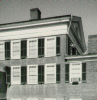 The south facade is laid in American bond. Where the addition joins the original structure, the first ten brick courses above grade are toothed in; there is a straight vertical joint between the two portions of the building above this level. The face brick in the original structure are 7-3/4" to 8" long by 3-5/8" to 3-7/8" wide by 2-3/8" to 2-1/2" high and laid so that six courses equals 1' 3-3/4"; the face brick in the addition are 8" to 8-1/4" long by 3-5/8" to 4-1/8" wide by 2-3/8" to 2-3/4" high and-laid so that six courses equals 1' 5-3/4". There is evidence of a red wash over the masonry of the basement of the addition.
The south facade of the original Jefferson building is five bays wide. The connection with the student room to the south takes up most of the western two bays at the basement and first story levels. The three bays to the east of the student room at the basement level contain a window, a door, and a window. The windows have 6-1/4" wide original two-fascia architraves (Types T-13 and T-14). The sills are 3" deep and project 1" past the face of the wall with no drip. The window on the west has 3/6 sash (panes 12" by 12") with an aluminum screen; the window on the east has a three-light top sash and a window air conditioner in place of the lower sash. The slightly recessed brick panels beneath the windows may be later infills (recessed 1/2" with no bonding to remaining wall areas). The doorway has a 6-1/2" wide two-fascia architrave (Type T-1). The door (Type D-2, 1953) is of 1" thick random-width (5 -1/8" to 7-3/4") beaded board with a pair of 4" butts and an iron box lock with a brass knob and keyhole escutcheon on the exterior. Pintles for shutters, now missing, are screwed into the architrave. There is a masonry threshold with a grooved aluminum sill.
The three bays on the east end of the first floor of the circa 1822 building have original 6/6 double-hung sash windows with two-fascia architraves (Type T-15). There are screens over the lower sash of the windows on each end. Each of the five bays on the second floor has an original window with a two-fascia architrave (Type T-15). The windows in the four bays to the east all have 6/6 double-hung sash with a screen over the bottom sash in each one. The window on the west has an air conditioner at the top with a six-light sash below. The exterior bottom portion of this window opening has been boarded up so that the roof of the range to the south could be butted against it. The architraves on both sides were shortened, and the sill was raised. The windows on the first and second floors are flanked by blinds except for the second window from the west on the second floor, which has a blind on the east side only. These blinds are relatively recent.
The 1919-20 extension has one window at the basement level and one at the first floor level. The basement window has a circa 1822 architrave (Type T-12) probably reused from the rear of the original pavilion, and 3/6 sash. There is a screen over the whole window. The window in the first story, dating from the end of the nineteenth century, has a molded architrave (Type T-10) and 6/6 double-hung sash. The lower sash is raised for a window air conditioner. This window is flanked by blinds.
 Investigation of the exterior elements of Pavilion II revealed approximately twenty-four layers of accumulated paint on some portions of the building. Wood elements including the cornices, pediments, window and door trim, and balcony were originally primed and painted in a yellowish white (Munsell 2.5 Y 9/1). Accumulated dirt is evident between each succeeding application of paint. The yellowish white was also applied to the underside of the suspended porch, the porch balustrade, and the porch ceiling. The second floor porch deck was first painted in a dark reddish gray (10 R 3/1).
 The stone bases of the four stuccoed columns have approximately five layers of paint with very evident layers of dirt between each layer of paint. The lesser number of paint layers and greater dirt build-up on stone surfaces, coupled with the appearance of these elements in an old photograph, indicates that they were originally unpainted. The column shafts are covered by at least seven layers of paint. The first coat of paint was a yellowish white; the more recent layers tend to be a purer white. Initially, the stuccoed shafts may not have been painted.
 The paired entrance doors at the first and second floors were originally grained to simulate mahogany. Later layers featured very dark greens.
The architrave of the main entrance door is now covered in a thick sand paint, which was recently applied. Originally, the trim was simply painted in a yellowish white (2.5 Y 9/1). There are approximately seventeen layers of paint on this feature.
 The window blinds at the first story level of the west facade have approximately twelve layers of accumulated paint. A light gray primer is followed by a dark yellowish green (2.5 G 3/4) and then a lighter forest green. The second story blinds were originally finished in a moderate yellow green (7.5 GY 7/4-6/4).
Investigation of the brick facade revealed that the masonry was at one point painted a brownish orange (terra cotta) color. The mortar joints were then painted white. This condition is still visible on the protected wall surface facing the second floor porch.
 Pavilion II was examined and analyzed to document its existing condition, to determine where repairs are needed, and to provide a better understanding of the changes and modifications that the building has undergone since its initial construction. The techniques used in the examination included visual investigation and description, measuring and drawing, and comprehensive photographic documentation of the building.
 As part of the physical investigation of Pavilion II, a preliminary paint analysis was undertaken to determine the original paint schemes of the interiors. Two methods of investigation were used to determine the historic paint colors. These included microscopic analysis of small samples of paint removed from painted surfaces such as plaster walls and wood trim, as well as the actual removal of paint by scraping, layer by layer, and then visually inspecting the exposed colors using a hand-held magnifier. The two methods reinforced eath other and acted as checks to minimize the possibility of error in the final color determination.
 The present arrangement of the basement is nearly identical with the two Jefferson floor plans, probably because the Jefferson plans were used as the basis for the 1953 restoration. The condition and configuration of the basement prior to 1953 is unknown at this time. The largest room, located on the south side, apparently functioned as the household kitchen. The cooking fireplace is still extant, although significantly restored. The northeast room originally contained the stairway to the first floor, as it does today. Whether the stair remained here in some form until 1953 is not known. Frederick Nichols noted the removal of "the small stair to the basement," which may have been constructed at some point at the east end of the original first floor lecture room, where there is evidence of floor patching. The original function of other basement rooms is unknown.
 The arrangement of the stair hall closely follows that shown in the Jefferson plans. One difference between the current configuration and the original plans is the door that Jefferson indicated in the east wall. What must have been the original rear doorway, however, is still intact in the middle bay of the rear wall of the original building, which would have been in the original kitchen. There was probably a window in the east wall of Room B01. This masonry opening was covered over when the first rear addition was constructed or when that addition was replaced in 1919-20.
 Open string stair with three winders to turn 90 degrees, a straight run of nine treads (running west to east), then a square landing to turn 90 degrees to enter the first floor, for a total of fourteen risers. The straight treads are 11" deep with a 1" nosing and 3' 0-1/2'' wide. All risers are 8" high. There are two 3/4" by 3/4" balusters per tread (approximately 5-3/8" on center) supporting a 2-1/4" diameter handrail. This staircase was constructed in 1953 following the layout shown on the Jefferson plan. Frederick Nichols removed an earlier staircase that was located in Room B03.
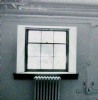 The original use for this room is not known, although two windows indicate that it was more than a storage space. It might have been a servant's room.
 The Jefferson plan indicates only one window opening, but physical evidence indicates that the two existing windows are original. As shown on the original plan, the chimney foundation, which projects from the south wall, does not have a fireplace opening.
The west vertical board partition was constructed in 1953 in the approximate location of a partition shown on the Jefferson plan.
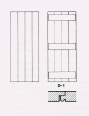
No. B021: 1953 door of 1" thick vertical beaded boards (7-1/2 to 8" wide) with three horizontal battens on the west side (Type D-l). Hardware: One pair of 4" butts (painted) and one cast-iron box lock (3-1/8" high by 4-1/4" wide) with keeper and brass knob, contemporary with the door.
No. B033: Nineteenth-century 1-1/4" thick stile-and-rail door with four flat panels (Type D-4). The jamb edge of the door has been sawn off, sanded, and left unfinished. A small ( 1") piece of wood has been nailed underneath the bottom rail. Hardware: One pair of 4" butts (painted) and one cast-iron box lock (3-1/8'' high by 4-1/4" wide) with brass knob (1953). The north face has a brass knob and oval keyhole escutcheon. Evidence for earlier hardware includes a 6-1/2" high by 3" wide patch at the current location of the knob on the north face and a 4" high by 2-3/4" wide patch on the south face. There is faint evidence of the original 4" high box lock and 3" high butt hinges.
No. B021: 1953 door of 1" thick vertical beaded boards (7-1/2 to 8" wide) screwed onto three horizontal battens on the west face (Type D-l). Hardware: One pair of 4" butts (painted) and one cast-iron box lock (3-1/8" high by 4-1/4" wide) with keeper and brass knob, contemporary with the door.
 This large and well lighted room is located on the south side of the original structure. It functioned as the kitchen, which served the professor living on the first and second floors.
 The original plans illustrate the room much as it is today with the exception of two openings that Jefferson shows as windows but which today are doorways. The doorway in the east wall appears to be the original back door which gave access to the exterior. The doorway in the south wall was added in the later nineteenth century.
The original cooking fireplace survives, although it is masked by later additions including a large and elaborate wood mantel installed in 1953. The west partition was constructed of boards in 1953 in the approximate position of a partition shown on the Jefferson drawings. 
No. B031: 1953 door of 1" thick vertical beaded boards (5-1/8" to 7-3/4" wide) screwed to three horizontal battens, with two diagonal braces (Type D-2). Hardware: Pair of 4" butts (painted) and iron box lock (3-1/8" high by 4-1/4" wide) with brass knob and key. Exterior face has brass knob and keyhole escutcheon. The hardware is contemporary with the door. The architrave (Type T-17) dates from the first half of the nineteenth century.
No. B032: Original 1-3/4", thick stile-and-rail door with four flat panels on the east face and four raised panels on the west face (Type D-3). Hardware: Pair of 4" butts (painted) and iron box lock (3-1/8" high by 4-1/4" wide) with brass knob, 1953. The east face has a brass knob and keyhole escutcheon. Evidence for earlier hardware includes a patch for a box lock, measuring 4-1/4" high by 5-5/8" wide, and patches on the hinge stile indicating 5" hinges.
No. B033: Nineteenth-century 1-1/4" thick stile-and-rail door with four flat panels (Type D-4). The jamb edge of the door has been sawn off, sanded, and left unfinished. A 1" wide piece of wood has been nailed underneath the bottom rail. Hardware: One pair of 4" butts (painted) and one cast-iron box lock (3-1/8" high by 4-1/4" wide) with brass knob. The north side has a brass knob and oval keyhole escutcheon, 1953. Evidence for earlier hardware includes a 6-1/2" high by 3" wide patch on the south side. There is evidence of the original box lock and 3" high hinges. The architrave (Type T-19) dates from the first half of the nineteenth century.
No. B034: 1953 door of 1" thick vertical beaded boards (average 8" wide) screwed to three horizontal battens on the west face (Type D-5). Hardware: Pair of 4" butts and one cast-iron box lock (3-1/8" high by 4-1/4" wide). There is a brass knob on each face. The hardware is contemporary with the door.
The untrimmed, plastered opening in the north wall received its current finish in 1953, although the Jefferson floor plans include an opening in this position.
The most important surviving feature in this room is the original window opening and trim located high in the west wall.
No. B034: 1953 door of 1" thick vertical beaded boards (averaging 8" wide) screwed to three horizontal battens on the west face (Type D-5). Hardware: Pair of 4" butts and one cast-iron box lock (3 1/8" high by 4 1/4" wide). There is a brass knob on each face. The hardware is contemporary with the door.
 There is no physical or documentary evidence for an enclosed addition to the rear of Pavilion II prior to 1892. In 1841, a rear porch was enlarged to be equal to the porch found at Pavilion IV.
 The 1856 Bohn engraving illustrates a balustraded porch at first floor level. Later photographs that record the upper story of the rear 1892 addition do not show the basement level. The circa 1920 aerial view indicates that, at that time, the addition was in the form that it retains today, except for the elaborate double stairway, which was constructed in 1953. The centered first floor entrance was originally located in the south bay of the rear elevation of the addition.
Room B04, surrounded on four sides by masonry walls, probably existed in this form prior to 1953. The wood mantel (circa 1890-1900) may have been located on the first or second floor of the rear wing shown in the 1897 photograph and constructed in 1892. It may have been placed here when the present addition was constructed in 1919-20 or during the 1953 renovation
No. B041: The 1-3/4" thick stile-and-rail door with two flat vertical panels set over two shorter raised panels (Type D-6) dates to 1892 or 1919-20. The molding of the two flat panels on the north face is new. The upper panels were previously glazed. A 1-1/4" wide board has been nailed to the hinge stile. Hardware: One pair of 4" butts (painted) and one cast-iron box lock (3-1/8" high by 4-1/4" wide) with brass knob. The north face has a brass knob and oval keyhole escutcheon with key. Evidence of earlier hardware includes a 5" high by 2" wide patch underneath the existing box lock on both faces and evidence for a mortise lock.
 The present arrangement of this hall with the two rooms to the north is the result of the 1953 remodeling. The only evident conditions that existed prior to that date are the masonry wall to the south and the opening and architrave of the rear entrance to the original pavilion, which still exist on the west wall.
No. B032: 1-3/4" thick stile-and-rail door with four flat panels on the east face and four raised panels on the west face (Type D-3). This door may be the original circa 1822 rear exterior door. Hardware: Pair of 4" butts (painted) and iron box lock (3-1/8" high by 4-1/4" wide) with brass knob. The east face features brass knob and keyhole escutcheon. Evidence for earlier hardware includes patch for a box lock measuring 4-1/4" high by 5-3/8" wide, and patches on the hinge stile indicating 5" hinges.
No. B041: The 1-3/4" thick stile-and-rail door with two flat vertical panels set over two shorter raised panels (Type D-6) dates to 1892 or 1919-20. The molding of the two flat panels on the north face is new. Formerly, the upper panels were glazed. A 1-1/4" wide board has been nailed to the hinge stile. Hardware: One pair of 4" butts (painted) and one cast-iron box lock (3-1/8" high by 4-1/4" wide) with brass knob. The north face has a brass knob and oval keyplate escutcheon with key. Evidence of earlier hardware includes a 5" high by 2" wide patch underneath the existing box lock, which shows on both faces, and a mortise lock.
No. B051: Door composed of 1" thick vertical beaded boards with three horizontal battens (Type D-7) dating to 1953. Hardware: One pair of 4" butts and one cast-iron box lock (3-1/8" high by 4-1/4" wide) with keeper and brass knob. The exterior face has a brass knob. Hardware is contemporary with the door.
No. B052: The 1-3/8" thick stile-and-rail door with four raised panels (Type D-8) dates to 1892 or 1919-20. Hardware: One pair of 3-1/2" hinges and one mortise lock. Each face of the door has a brass knob set into a 2-1/4" wide by 7" high brass plate. The strike plate is stamped "Y59." There is evidence for an earlier, larger mortise lock.
No. B071: Door composed of 1 3/8" thick stile-and-rail door with two flat panels (Type D-9) dating to 1953. Hardware: One pair of 4' butts and one cast-iron box lock (3 1/8" high by 4 1/4" wide) with keeper. There is a brass knob on the south face. The north face had a brass knob, rose, and keyhole escutcheon. The hardware is contemporary with the door.
 Concrete, painted gray, probably installed 1953.
 No. B052: The 1-3/8" thick stile-and-rail door with four raised panels (Type D-8) dates to 1892 or 1919-20. Hardware: One pair of 3-1/2" hinges and one mortise lock. On each face of the door there is a brass knob set into a 2-1/4" wide by 7" high brass plate. The strike plate is stamped "Y59." There is evidence for an earlier larger mortise lock. This door may have been removed from the first floor of the first floor of the rear wing and placed here in 1953 or later.
 This room appears to be part of the 1953 remodeling.
No. B071: The 1-3/8" thick stile-and-rail door with two flat panels (Type D-9) dates to 1953. Hardware: One pair of 4" butts and one cast-iron box lock (3-1/8" high by 4-1/4" wide) with keeper. There is a brass knob on the south face. The north face has a brass knob, rose, and keyhole escutcheon. The hardware is contemporary with the door.
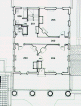
 Jefferson's drawings for Pavilion II illustrate a scheme of modest dimensions but unusual plan. Pavilion II is the only pavilion in which the entrance opened into a small, restrictive vestibule. This small, square space provided access to the large lecture room, which extended the full depth of the pavilion on its south side, and to the smaller room on the north side, which most likely originally functioned as the professor's study. Later, the use of this north room probably changed depending on the needs of the occupant. Beyond the study was the stair hall, which provided access to the other portions of the professor's private domain both in the basement (kitchen) and on the second floor (parlor and bedchambers).
 The detailing of Jefferson's plans for Pavilion II is very schematic, particularly for the stairway. A better understanding of his intent can be gained by studying the plans that are attributed to Cornelia Jefferson Randolph or John Neilson , where the stair arrangement is much more clearly presented, especially at the second floor.
 Documentation and physical evidence indicate that the first floor plan was modified several times during the nineteenth century. The earliest change for which there is physical evidence occurred in 1829, when a partition was constructed across the west end of the large south room on the first floor at the request of Professor Johnson . Further modifications may have involved moving the lower flight of stairs from its original freestanding position to a location against the east wall. A partition was constructed at the west end of the study (104) in 1839. The east partition may have been moved and the main stairway (103) modified for Professor Cabell.
 All reasons for the modifications are not known, and there is no documentation to indicate whether the first floor rooms were used for their intended purposes. It is possible that the lecture room was used for anatomical demonstrations until the Anatomical Theater was completed in 1826. The first floor was extensively restored beginning in 1953 under the direction of Frederick Nichols following Jefferson's plan.
 The configuration of the present rear wing dates to 1919-20, when the long, narrow 1892 wing was removed. Some form of addition may have been constructed during the earlier nineteenth century. Neither the configuration nor the extent of this possible addition is known, but what may have been a similar basement story addition was constructed at the rear of Pavilion I in 1832. In 1841, a porch at the rear of the pavilion was renewed and enlarged. The 1850 Duval lithograph illustrates what appears to be a basement level addition across the rear of the pavilion. Although the porch is not clearly indicated in the Duval lithograph, a railing indicating the edge of a porch is clearly shown at the rear of the first story level in a Bohn engraving of 1856.
An 1897 photograph of the reconstruction of the Rotunda shows the uppermost portion of what must be a three-story wing extending from the rear of Pavilion II. This wing cannot be seen in a circa 1899 photograph from the southwest. A turn-of-the-century campus plan illustrates a long, narrow addition extending from the north end of the rear elevation, which explains why the wing was visible only in views of the north side. None of the early illustrations provides enough information to determine the extent or appearance of the rear addition at the first floor and basement levels.
A circa 1920 aerial photograph illustrates the east addition in its current configuration except for the rear porch and stairs, which were added during the 1953 remodeling. The rear door was in its original position in the south bay.
Both the Jefferson plan and the plan attributed to Cornelia Jefferson Randolph or John Neilson depict this space as it appears today. In fact, this room is a part of the reconstruction initiated in 1953. Prior to this work, the entrance hall extended fully across the front (west) end of the first floor. There is ample evidence for this configuration in Rooms 102 and 104. This former hall was the same depth as the present space and had two doorways, which provided access into the neighboring rooms. This hall evolved from modifications made to the original plan in 1829, when the south partition was added, and 1839, when the north partition was added.
The only surviving original finishes include the paired entrance doors, the transom, the door architrave and possibly the flooring. The doors in the openings into the flanking rooms may be the elements originally in these positions, which were removed to new locations when the hall was extended across the pavilion. Their openings and architraves were recreated in 1953.
No. 1011: Pair of original 1-3/4" thick stile-and-rail leaves, each with three raised panels (Type D-10). Hardware: Each leaf has an original pair of 4-3/4" iron butts. The north leaf has a recent brass mail slot in the center rail and original surface-mounted iron sliding bolts in the top and bottom rails secured by handwrought screws. The south leaf has a later brass mortise lock with a brass knob, rose, keyhole escutcheon and swinging keyhole cover on both sides. Above the lock is a "Corbin" surface-mounted dead bolt and a brass slide bolt. The outline of the original 5-3/4" x 8-3/4" box lock is visible on the inside face of the south leaf.
No. 1023: Original 1-3/4" thick stile-and-rail door with six raised panels (Type D-ll). It is not known whether this door was originally in this location. Hardware: Pair of 4-3/4" iron butts and a 6-1/4" high brass mortise lock (1953), stamped "Fontaine, Paris," with keeper. Each side of the door has a brass knob, rose, and keyhole escutcheon with swinging keyhole cover. There is evidence of an earlier original mortise lock on the west stile.
No. 1041: Original 1-3/4" thick stile-and-rail door with six raised panels (Type D-ll). It is not known whether this door was originally in this location. Hardware: Pair of 4-3/4" iron butts and a 6-1/4" high brass mortise lock (1953), stamped "Fontaine, Paris," with keeper. Each side of the door has a brass knob, rose, and keyhole escutcheon with swinging keyhole cover. There is evidence of an original box lock (4 -3/4" by 7-3/4") and hinges.
All of the doors were originally grained to imitate mahogany. The plaster wall surfaces date from the 1953 restoration, and the only evidence for an early paint finish on these surfaces was found on top of the original door architrave on the west wall. A small amount of a bright yellow, similar to the color originally used on the hall walls of Pavilion I, survives in this location. Another color, possibly later nineteenth century or early twentieth century, can be discovered on a small fragment of plaster attached to the north side of the front door architrave. This was a light yellowish pink (5 YR 3/4).
 This unusually configured space, the largest room in the pavilion, was one of the largest lecture halls in the original ten pavilions. It is not known when this impressive room was incorporated into the professor's living quarters. The doors in the north partition give access to the front and rear vestibules, and the partitions forming these spaces actually project into the corners of the room. These projections and the deep chimney breast form an unusual architectural configuration along the north wall. This room was recreated by Frederick Nichols in 1953 following the original Jefferson plan.
 In the restoration, partitions were removed from the east and west ends of the room. There is still evidence on the flooring for a central doorway in the former west partition, which provided access from the hallway created in 1829. When the east partition was removed, a stairway, which provided access to the basement, was also removed and the opening covered over. Prior to 1953 there was a small pantry located at the east end of the room beyond the former partition. Perhaps the modifications found here until 1953 were part of the work undertaken in 1841, which included altering and finishing a closet commenced by Professor Johnson (1829-34).
 Original woodwork surviving in its initial location includes all of the window architraves and sash (south and west walls) as well as the baseboard on the west wall and a portion of that on the south wall. The wood cornice on the north and west walls is original fabric but may not be in its original location. The rest of the cornice was installed circa 1953. The mantels, the chair rail, and the door architraves as well as extensive portions of the baseboard were all created as part of the 1953 restoration.
No. 1021: 1953 1-3/4" thick stile-and-rail door with six raised and bevelled panels (Type D-12). Hardware: Pair of 4-3/4" iron butts and a 6-1/4" high brass mortise lock (1953), stamped "Fontaine, Paris," with keeper. Each side has a brass knob, rose, and keyhole escutcheon with swinging keyhole cover, which are contemporary with the lock.
No. 1022: 1953 1-3/4" thick stile-and-rail door with six raised and bevelled panels (Type D-12). Hardware: Pair of 4-3/4" iron butts and a 6-1/4" high brass mortise lock (1953), stamped "Fontaine, Paris," with keeper. Each side has a brass knob, rose, and keyhole escutcheon with swinging keyhole cover, which are contemporary with the lock.
No. 1023: This is an original pavilion door placed here as part of the 1953 restoration. It may have been in this position prior to the 1829 remodeling, which created the long front hall. It is a 1-3/4" thick stile-andrail door with six raised panels (Type D-ll). Hardware: Pair of 4-3/4" iron butts and a 6-1/4" high brass mortise lock (1953), stamped "Fontaine, Paris," with keeper. The door has a brass knob, rose, and keyhole escutcheon with swinging keyhole cover, contemporary with the lock, on each side. There is evidence of an earlier original mortise lock on the west stile.
Samplings from original sections of the cornice revealed two different paint sequences, which would be expected due to the early remodeling of the room. All old sections were first finished in the yellowish white (2.5 Y 9/2). Some sections, including the area above the door to the front hall, were next covered with a yellow paint, while the section above the mantel (probably never moved) was painted in a light beige. The section above the front hall doorway has approximately twenty-five layers of paint. The two middle layers featured a deep red and a bright green.
The door opening from the front hall (No. 1023) retains evidence of original mahogany graining.
There are three layers of white paint on the wood mantel installed in 1953.
The wall surfaces are covered in plaster dating to 1953. A small sample removed from above the west window revealed the same strong yellow paint formed in the entrance hall. This color was probably applied after the hall was enlarged in 1829.
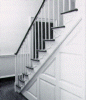 The present configuration of this spacious stair hall is the result of the 1953 restoration. It matches the arrangement shown in both the plan by Jefferson and the plan attributed to Cornelia Jefferson Randolph or John Neilson and apparently replicates the original condition. The stairway provides access to the basement and the second floor. The doorway in the south wall originally led from the rear entrance vestibule into the lecture room. A doorway in the west partition opened into the professor's study. The doorway in the east wall (originally a window) now opens into a toilet room located in the rear addition. Two original windows in the north wall provide ample light.
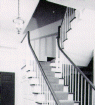 The surviving original features in this space include the landing and upper run of the stairway, the architrave and transom of the former rear doorway, and the two windows with their architraves, paneled reveals, and sash. The flooring also dates from the original construction.
Prior to 1953, the bottom run (thirteen risers) of the stairway ascended against the rear (east) wall to the existing landing. When and if this modification was made to the supposed original Jefferson configuration is not known. The change may have been in 1839 when Professor Cabell had his dining room (104) modified. When the stairway was positioned against the wall, it may have related to the window in that position in the same manner as the original stairway in Pavilion I.
A partition starting between the two windows on the north wall and extending to the south was removed in 1953. At that time this partition formed the east end of Room 104 and enclosed a much smaller stair hall. Like the stair modification, this former partition may have been placed here in 1839.
No. 1022: 1953 1-3/4" thick stile-and-rail door with six raised and bevelled panels (Type D-12). Hardware: Pair of 4-3/4" iron butts and a 6-1/4" high brass mortise lock (1953), stamped "Fontaine, Paris," with keeper. Each side of the door has a brass knob, rose, and keyhole escutcheon with swinging keyhole cover, which are contemporary with the lock.
< No. 1031: 1953 1-3/4" thick stile-and-rail door with six raised and bevelled panels (Type D-12). Hardware: Pair of 4-3/4" iron butts and a mortise lock marked "P4, " with brass knob, rose, and keyhole escutcheon with swinging keyhole cover on each side. This lock replaced a "Fontaine" lock.
No. 1032: 1953 1-3/4" thick stile-and-rail door with six raised and bevelled panels (Type D-12). Hardware: Pair of 4-3/4" iron butts and a 6-1/4" high brass mortise lock (1953), stamped "Fontaine, Paris," with keeper. Each side of the door has a brass knob, rose, and keyhole escutcheon with swinging keyhole cover, which are contemporary with the lock.
No. 1033: 1953 1" thick stile-and rail door with six flat panels (Type D-13). Hardware: Pair of iron butts and a 4-1/4" high by 3-1/8" wide cast-iron box lock with brass knob. Small bronze finish mortise bolt with ellipsoid knob.
The surviving original upper run of the stairway reveals that the same yellowish white was used on the stringer, the newels, and the balusters. The risers were first covered in the yellowish white followed by a bright yellow (2.5 Y 8.5/8) covered by a reddish glaze forming a layer of wood graining. The treads were first finished in a red/brown color.
All of the original plaster wall surfaces in this space have been disturbed. A very small fragment of wallpaper was found adhered to the right side of the architrave of the former rear doorway.
A description of the work undertaken by Frederick Nichols refers to the removal of "vestiges of wallpaper printed with a rusticated stone design." This description indicates a typical pattern for hall wallpaper from the early to mid-nineteenth century. It is not clear where this paper was found. Such paper would be appropriate for the front entrance hall (Room 101) and this stair hall.
Paint sampling of original plaster surviving in the upper portion of the stairwell (next to the later stair flight to the attic) revealed a pale orange yellow (7.5 YR 8/6) covered by traces of wallpaper.
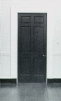 This large room, an original portion of the professor's private living quarters, was designed to serve as the professor's study. The most recent occupant of the pavilion, Professor Edwin E. Floyd , followed this tradition. During the residency of Professor Cabell the room served as the dining room, as it may have for other occupants. The existing room arrangement is the result of the 1953 restoration, which recreated the original Jefferson plan. The existing layout differs only from the presumed original in one minor point. On both the Jefferson plan and on that attributed to Cornelia Jefferson Randolph or John Neilson , the chimney breast projects out from the south wall, forming a small recess next to the east partition. In the present configuration, this recess has been covered over by an extension of the front face of the chimney breast. Investigation revealed a hollow space behind the wall surface in this position.
 The room is entered by a door from the small front hall. A doorway in the east partition leads to the stair hall. Single windows in the west and north walls provide natural light. A chimney breast projects in an awkward position in the southeast corner.
This room was extensively modified during the nineteenth century. In 1839 a partition was constructed across the west end of the space. This partition extended across the entrance hall and joined to the partition added in the lecture room (Room 102) in 1829. This created a long spacious hallway across the front of the pavilion. At the same time, the east partition in Room 104 may have been shifted eastward into the stair hall. The result would have been a room of approximately the same size as the original but with the chimney breast centered on the south wall. To accommodate this last change, the stairway in Room 103 was moved to a position against the east wall.
Marks on the flooring and on the wood cornice of the south wall provide ample evidence for the location of the west partition and indicate the location of the doorway, which was centered in the partition.
Original finishes in this room include large expanses of the wood cornice, the window architraves, reveals, and sash, and a small section of baseboard attached to the west end of the chimney breast. The flooring is also original.
No. 1032: 1953 1-3/4" thick stile-and-rail door with six raised and beveled panels (Type D-12). Hardware: Pair of 4-3/4" butts and a 6-1/4" high brass mortise lock (1953), stamped "Fontaine, Paris," with keeper. Each side of the door has a brass knob, rose, and keyhole escutcheon with swinging keyhole cover, which are contemporary with the lock.
No. 1041: Original 1-3/4" thick stile-and-rail door with six raised panels (Type D-ll ). Hardware: Pair of 4-3/4" iron butts and a 6-1/4" high brass mortise lock (1953), stamped "Fontaine, Paris," with keeper. Each side of the door has a brass knob, rose, and keyhole escutcheon with swinging keyhole cover, which are contemporary with the lock. There is evidence of the original box lock (4-3/4" by 7-3/4") and hinges. Although this is an original door, it is not possible to determine whether it was originally in this location.
Most of the wall surfaces have been replastered, but an early surface was discovered high up on the plastered face of the chimney breast. This rough sandy plaster was originally covered in a cream/white paint followed by a wallpaper. Only minute traces of this paper were found. The corresponding rooms in Pavilions I and VI were also originally wallpapered.
 Rooms 105, 106, and 107 are located in the rear addition, which received its present external form sometime between 1919 and circa 1920. This addition replaced an earlier wing constructed in 1892.
 This former rear wing included a basement, first floor, and second floor. The configuration of the two lower floors is not known, but photographic evidence indicates that the second story consisted of a long narrow wing that extended from the north end of the rear (east) elevation. A porch existed along the rear east side of the original pavilion and on the south side of the rear wing. Some of the wood finishes of the 1892 wing can be found in the addition that exists today.
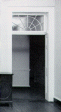 By 1953, the rear addition included a kitchen, bedroom, and bathroom. It was at this time that Frederick Nichols remodeled the rear wing and created the present arrangement, which includes a dining room (105), kitchen (106), and bathroom (107).
The use and configuration of the space included in Room 105 prior to 1953 is not known. Physical evidence, in the form of an encased ceiling beam, may indicate the location of a former partition that enclosed a hallway on the north side of the space.
The architectural finishes in the dining room include the original rear door architrave and glazed transom, later window trim and sash, and restoration woodwork introduced by Frederick Nichols. An anomaly in the room is the circa 1810 mantelpiece and the mid-nineteenth century cast-iron fireplace insert. These were apparently removed from the basement and placed here in 1953. When they were placed in that earlier position is not known.
No. 1021: 1953 1-3/4" thick stile-and-rail door with six raised panels (Type D-12). Hardware: Pair of 4-3/4" iron butts; a 6-1/4" high brass mortise lock (1953), stamped "Fontaine, Paris," with keeper. Each side of door has a knob, rose, and keyhole escutcheon with swinging keyhole cover, contemporary with the lock.
No. 1051: Pair of 1-3/4" thick stile-and-rail leaves (1953), each with three raised panels (Type D-14). Hardware: Each leaf has a pair of iron butts. North leaf has one 5-7/8" wide by 3-1/2" high cast-iron box lock with brass knob, one "Corbin" surface-mounted dead bolt, and one brass slide bolt. The exterior face of the north leaf has a brass knob and keyhole escutcheon with swinging keyhole cover. The south leaf has extension flush bolts on the north stile. All of this hardware is contemporary with the door. This opening was a window prior to the 1953 renovation.
No. 1061: 1953 1-3/4" thick stile-and-rail door with six raised and beveled panels (Type D-15). Hardware: Pair of iron butts and mortise lock. Brass knob and 7-1/4" high brass plate on north face; brass knob and keyhole escutcheon with swinging keyhole cover on south face. The hardware is contemporary with door.
 Frederick Nichols stated that prior to 1953 the
"addition at the rear contained a kitchen, bedroom and bath"; it has not been determined whether this earlier kitchen was located in this room or in the basement. All wood door and window trim and baseboards in this room were installed here in 1919-20 but may have originated from the 1892 rear addition.
Frederick Nichols stated that prior to 1953 the
"addition at the rear contained a kitchen, bedroom and bath"; it has not been determined whether this earlier kitchen was located in this room or in the basement. All wood door and window trim and baseboards in this room were installed here in 1919-20 but may have originated from the 1892 rear addition.
No. 1061: 1953 1-3/4" thick stile-and-rail door with six raised and beveled panels (Type D-15). Hardware: Pair of iron butts and mortise lock. Brass knob and 7-1/4" high brass plate on south face; brass knob and keyhole escutcheon with swinging keyhole cover on north face. Hardware is contemporary with the door.
No. 1062: Pair of 1" thick stile-and-rail doors ( 1953), each with three flat panels (Type D-16). Hardware: Pair of 3-1/4" high butts and chrome-plated knobs, contemporary with the door.
No. 1062: Pair of 1" thick stile-and-rail doors ( 1953) with three flat panels (Type D-16). Hardware: Pair of 3-1/4" high butts and chrome-plated knobs, contemporary with the doors.
 This room was created as part of the 1953 renovation of the rear addition. The location of the earlier bathroom, referred to by Nichols , is not known. The only pre-1953 finishes that survive are the 1892 and/or 1919-20 window trim and sash.
No. 1031: 1953 1-3/4" thick stile-and-rail door with six raised and beveled panels (Type D-12). Hardware: Pair of 4-3/4" butts and a mortise lock marked "P4." Each side of the door has a brass knob, rose, and keyhole escutcheon with swinging keyhole cover. This lock replaced an earlier (1953) lock.
No. 1071: 1953 1-3/8" thick stile-and-rail door with two flat panels (Type D-17). Hardware: Pair of 4" butts and a brass mortise lock marked "Y58" and keeper. Each side of door has a brass knob set into a 7" high plate. Hardware is contemporary with the door.
No. 1071: 1-3/8" thick stile-and-rail door (1953) with two flat panels (Type D-17). Hardware: Pair of 4" butts and a brass mortise lock marked "Y58" and keeper. Each side of the door has a brass knob set into 7" high plate. The hardware is contemporary with the door.
 Fortunately, the second floor of Pavilion II was not extensively modified during the nineteenth century, and there was thus little need to intervene in this century. Surviving drawings of the second floor plan include the original one by Jefferson and a more detailed version attributed to Cornelia Jefferson Randolph or John Neilson. The latter drawing illustrates the plan much as it exists today.
 The compact layout is defined by a narrow hallway that bisects the plan into equal east and west sections. A large parlor and smaller bedchamber are located on the west side of the hall. Arranged on the east side are a large bedchamber, a narrow stair hall that extends back to the rear exterior wall, and a small dressing room or bedroom, now divided into two bathrooms. There is a corner fireplace in each of the three large rooms.
 A stairway leading to the attic was constructed as a continuation of Jefferson's stair in the late nineteenth or early twentieth century. Other modifications to the plan have been restricted to the small room located in the northeast corner. This room was probably first modified when a wing was constructed in 1892 extending eastward from the rear of the pavilion. This three-story extension is visible in an 1897 photograph. The narrow room, which now includes the two bathrooms, may have served as a corridor leading to this addition. Evidence on the exterior of the east window of Room 206 indicates that the window was moved or enlarged at some time in the past. The most recent modification, part of the 1953 restoration, involved the creation of the two bathrooms presently situated in the northeast corner of the second floor.
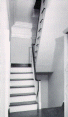 This narrow and windowless stair hall retains its original appearance with the exception of the continuation of the stairway to the attic. This stair, constructed in the late nineteenth century or early twentieth century, duplicates the detailing of the original flight below it. The form and location of the attic access prior to the addition of this stairway has not been determined.
 An investigation behind the baseboard attached to the north wall, which follows the lower flight of the attic stair, revealed original stairwell wall plaster. The wallpaper in place when this stair was constructed is still attached to the plaster in this position.
The upper flight of the first floor staircase (the five treads, landing, and balustrade) is original fabric. Prior to the construction of the attic staircase, the handrail of this upper flight rose to the second floor where it turned towards the north to abut the wall enclosing the bathroom (Room 206).
No. 2061: 1953 1-5/8" thick stile-and-rail door with six raised and beveled panels (Type D-21). Hardware: Pair of 3-1/2" butts and a 6-1/4" high brass mortise lock (1953), stamped "Fontaine, Paris," with keeper. On each side there are a brass rose, knob, and keyhole escutcheon with a swinging keyhole cover, which are contemporary with the lock.
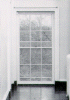 The floor plan drawn by Cornelia Jefferson Randolph or John Neilson illustrates the hall exactly as it is today. The dramatic quality of this hall is the result of its narrow dimension and the low windows positioned at the ends. The doorways lead into the former parlor and a bedchamber on the west side and a large bedchamber and a bathroom on the east.
No. 2031: Original 1-3/4" thick stile-and-rail door with six raised panels (Type D-18). Hardware: Pair of 4-1/2" butts and a 6" high brass mortise lock (1953), stamped "Fontaine, Paris," with strike. Each side has a brass rose, knob, and a keyhole escutcheon with a swinging keyhole cover, which are contemporary with the lock. There is evidence for an earlier original mortise lock. This door was originally located in the position of door number 2043.
No. 2043: Original 1-3/4" thick stile-and-rail door with six raised panels (Type D-18). Hardware: Pair of 4-1/2" butts and the original 4-3/4" high by 8" long iron box lock mounted on the west side of the door with keeper. The door has the original brass knob on the west and a brass rose, knob, and keyhole escutcheon on the east. This is the only original lock that survives in the pavilion. This door was originally located in opening 2051 across the hall.
No. 2051: Original 1-3/4" thick stile-and-rail door with six raised panels (Type D-18). Hardware: Pair of 4-1/2" butts and a 6-1/4" high brass mortise lock (1953), stamped "Fontaine, Paris," with keeper. Each side has a brass rose, knob, and a keyhole escutcheon with a swinging keyhole cover, which are contemporary with the lock. This door was originally located in the hall door opening (No. 2031) into bedchamber 203. In that position it had a box lock.
No. 2071: Original 1-3/4" thick stile-and-rail door with six raised panels (Type D-18). Hardware: Pair of 4-1/2" butts and a 6-1/4" high brass mortise lock (1953), stamped "Fontaine, Paris," with keeper. Each side has a brass rose, knob, and keyhole escutcheon with a swinging keyhole cover, which are contemporary with the lock. There is evidence of the original box lock (5" by 7-3/4"). This door has probably always been in this position, although the opening was modified in 1953.
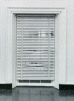 This bedroom or chamber, in the northwest corner of the second floor, survives with all of its original wood work. The only modification may have been the insertion of the doorway in the south partition at a very early date. The cast-iron Franklin stove was placed in the fireplace opening in 1953.
 There is a doorway to the hall in the east partition, and there are windows in the north and west walls.

No. 2031: Original 1-3/4" thick stile-and-rail door with six raised panels (Type D-18). Hardware: Pair of 4-1/2" butts and a 6" high brass mortise lock (1953), stamped "Fontaine, Paris," with strike. Each side has a brass rose, knob, and a keyhole escutcheon with a swinging keyhole cover, which are contemporary with the lock. This door was originally located in opening 2043, where it had an earlier mortise lock.
No. 2042: 1-7/16" thick stile-and-rail door with six raised panels (Type D-20), which is not original but is an early addition. Hardware: Pair of 4-1/2" butts and a 6-1/4" high brass mortise lock (1953), stamped "Fontaine, Paris," with keeper. Each side has a brass rose, knob, and a keyhole escutcheon with a swinging keyhole cover, which are contemporary with the lock. There is evidence for the position of the original lock keeper on the trim.
 An 1830s-style cast-iron stove with brass ornament and finials (installed in 1953) is inserted in a plaster surface 3' 8-1/4" wide and 3' 6" high. The original wood mantelpiece is composed of a 6" wide two-fascia architrave at the sides and top. Above the architrave is a 6" high frieze topped by a 6" high denticulated cornice. There is a 1' 8" deep by 3' 10-1/2'' wide brick hearth in front of the mantelpiece. The bricks are approximately 4-1/8" wide by 8-1/2" long.
 No early paint layers were found on the plaster walls, which were repaired in 1953.
 This large, elegant room was originally created to serve as the professor's parlor. The boldly ornamented entablature marked this as the finest room in the pavilion.
 The plan reflects the one drawn by Jefferson, which shows the doorway in the north partition but in a slightly different position. The Randolph-Nielson drawing does not indicate this feature, and physical evidence suggests that the doorway was a very early addition.
 The fine original wood mantel now incorporates an early cast-iron Franklin stove, which was borrowed from Monticello as part of the 1953 restoration. This is the type of stove that the original drawings indicate was to be used on the second floor. Three stoves were purchased for this pavilion in 1821. A similar stove survives on the second floor of Pavilion VII. An original or very early feature, which partially survives, is the iron and brass lever from which a service bell cord was suspended. It is attached to the entablature frieze just east of the angled chimney breast. A small hole (for a connecting wire) penetrates the wall and enters the hall (Room 202). It has not been possible to trace the path of the missing wire further.
The room has doors in the north and east partitions and a pair of doors that provide access to the porch beyond the west wall. In keeping with the more formal character of this space, the windows in the west and south walls have more ornately panelled reveals than those in other rooms.
No. 2041: Original exterior door with two 1-3/4" thick stile-and-rail leaves (Type D-19). Each leaf has three panels, which are flat on the exterior and raised on the interior. Hardware: Each leaf has one pair of original 4-1/2" iron butts, and the leaves have a 4-1/2" by 7-3/4" box lock and keeper with brass knobs both sides and a brass rose, brass keyhole escutcheon, and a brass swinging keyhole cover on the exterior. The south leaf has original surface-mounted iron and brass sliding bolts top and bottom. There is recent surface-mounted brass weatherstripping at the bottom of both leaves on the interior. Screw holes and marks in the wood on both leaves about six inches above the lock rail indicate that a locking or latching device was previously installed in this location. The door originally had a mortise lock like that originally used on the door in the east partition.
No. 2042: 1-7/16" thick stile-and-rail door with six raised panels (Type D-20) that is early but not original. Hardware: Pair of 4-1/2" iron butts and a 6 1/4" high brass mortise lock (1953), stamped "Fontaine, Paris," with keeper. Each side has a brass rose, knob, and keyhole escutcheon with a swinging keyhole cover, which are contemporary with the lock.
No. 2043: Original 1-3/4" thick stile-and-rail door with six raised panels (Type D-18). Hardware: Pair of 4-1/2" iron butts and the original 4 3/4" high by 8" long iron box lock mounted on the west side of the door with keeper. The door has a brass knob on the west and a brass rose, knob, and keyhole escutcheon on the east, which are contemporary with the lock. This door was originally located in opening No. 2051.
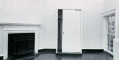 This bedchamber, in the southeast corner of the second floor, retains all of its original architectural features. The Randolph-Neilson plan portrays the room as it was constructed and as it survives today. The Jefferson plan curiously shows a doorway in the north partition, which, if actually constructed, would have opened out into the stairwell in an impossible position.
 The cast-iron Franklin stove was placed in the fireplace opening in 1953. There is a doorway to the hall in the west partition, and there are windows in the south and east walls.
No. 2051: Original 1-3/4" thick stile-and-rail door with six raised panels (Type D-14). Hardware: Pair of 4-1/2" iron butts and a 6-l/4" high brass mortise lock (1953), stamped "Fontaine, Paris," with keeper. Each side has a brass rose, knob, and a keyhole escutcheon with a swinging keyhole cover, which are contemporary with the lock. This door was originally located in opening No. 2031. In that position it had a box lock.
 The wood trim including the cornice, mantel, and the crown molding of the baseboard was first finished in a yellowish white (2.5 Y 9/2). The cornice was next covered in a grayish red (10 R 5/2). The vertical face of the baseboards and the top surface and outer edge of the mantel shelf were finished in the moderate reddish brown ( 10 R 3/4). The door was grained to imitate mahogany.
The date of the first modification to the space that is now Rooms 206 and 207 is unknown. It probably occurred in 1892, when the rear wing was first constructed. This area would have provided the only means of access to that wing without passing through the bedchamber (Room 205). This rear wing is best illustrated in an 1897 photograph. The rebuilt brickwork outside of the window in the east wall may be evidence for a door opening into this former wing.
The existing bathroom arrangement apparently was created as part of the 1953 restoration. Prior to that time, Rooms 206 and 207 may have functioned as a single large bathroom. Frederick Nichols refers to the pre-1953 space as a "large dressing room."
A curious condition exists with the floor structure beneath the south partition, which can be viewed from the plumbing access hatch behind the bathtub. A massive east-west floor joist (header), into which the northsouth joists are mortised, rests not below the south partition as would be expected, but rather several inches to the north of it. Investigation of the partition revealed that it had been resurfaced, perhaps in 1953, but the wood studs and evidence of original lath seem to indicate that the structure of the partition is contemporary with the construction of the pavilion. Additional probing may reveal that the original structural elements of this partition were moved at some time in the past.
No. 2061: 1953 1-3/4" thick stile-and-rail door with six raised and beveled panels (Type D-21). Hardware: Pair of 3-1/2" butts and a 6-1/4" high brass mortise lock (1953), stamped "Fontaine, Paris," with keeper. Each side has a brass rose, knob, and a keyhole escutcheon with a swinging keyhole cover, which are contemporary with the lock.
 This bathroom was created in 1953, and the earlier history of the space relates to that of Room 206.
 Plaster on masonry and expanded metal lath (1953), painted. Above the bathtub on east, south, and west walls there is 4-1/4" square white glazed tile on a mortar bed. The surface of the tile is 3/4" in front of the wall behind.
 No. 2071: Original 1-3/4" thick stile-and-rail door with six raised panels (Type D-18). Hardware: Pair of 4-1/2" iron butts and a 6-1/4" high brass mortise lock (1953), stamped "Fontaine, Paris," with keeper. Each side has a brass rose, knob, and a keyhole escutcheon with a swinging keyhole cover, which are contemporary with the lock. This door originally had a 5" by 7-3/4" box lock on the current hinge stile.
 The stairway providing access to the attic descends near the northeast corner. Machine-made nails used in the construction of this stairway indicate that it was built at the end of the nineteenth century or early in the twentieth century. The location of the original access to the attic is not evident. It may have been a simple hatchway located in the same position as the current stair opening.
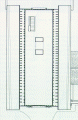 The original, impressive brick chimney mass dominates the center of the large open space. Two separate chimneys join just above the floor in a low rounded arch and rise in a single large mass through the roof.
The large unused space located at the front end of the pavilion between the attic floor and the ceiling of the front portico is accessible through an opening created by removing some of the floor boards. A small cache of original (1822) first and second floor trim is stored in the southeast corner behind the knee wall. This material should be inventoried and preserved.

 Two chimney masses (each approximately 4' 3" by 2' 3") spaced 4' 5" apart rise from the space below. The inner sides of the masses arch towards each other beginning at floor level and meet 2' 1-1/2" above the floor halfway between them. The outer faces rise 3' 2-1/2" above the floor, where they are recessed 1' 0" and then corbel inward to form a mass 4' 3" wide and 4' 6" long that projects through the roof.
The reconstructed garden of Pavilion II was described as follows:
The Pavilion II garden is the nearest to the Rotunda and, therefore, is the smallest of the East Lawn gardens. It is divided by a serpentine cross wall. A brick terrace constructed next to the pavilion is accessible by gates in the flanking walls. From either side of the terrace curving walks with steps, following the grades, descend to an intermediate lower level. On this upper lawn a decorative bench, set against a hedge of southern wax myrtle, accents the central axis. An existing umbrella tree and a maidenhair tree are reminders of Jefferson's interest in new plant importations. The side paths connect with the privies and gates to the lowest level. Between these a path parallels the serpentine division wall against which fig trees are espaliered. In the center, on either side, are grape trellises underplanted with herbs. Benches provide pleasant places to rest. Below the dividing wall a steep bank with steps on the lateral paths leads to the hotel garden. This level area is laid out in four square panels with four pear trees planted symmetrically in each. At the very foot of this garden another steep bank with steps to a central gate gives access to the terminal platform. From here additional steps lead down to the hotel. Note: 1
This description indicates the difficult problem of grades that was resolved in this restoration based on Jefferson's seemingly simple, two-dimensional plan. The several levels in all the east gardens could not be determined by the continuous slope of the side walls. They had to be deduced from internal evidence, such as the grade of existing plants and cross walls or steps.
The following plants were included in the Hopkins design. Note: 2
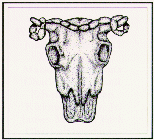 Table of Contents